
 Being told you have a herniated disc is scary enough. Being told the next step is surgery — with its risks, its long recovery, and no guarantee it even works — is worse. Before you accept that surgery is your only option, it is worth understanding what a herniated disc actually is and why many of them improve without an operation.
What a herniated disc actually is
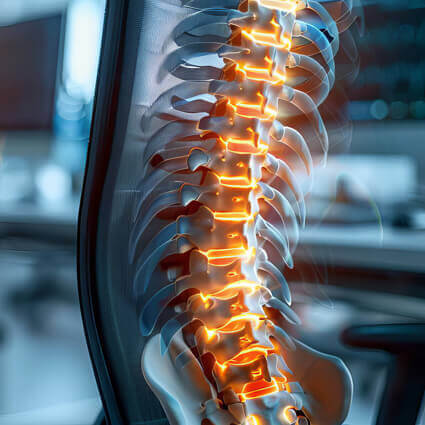
Your spinal discs are cushions between the vertebrae, each with a tough outer ring and a softer gel center. A herniation happens when that inner gel pushes through a tear in the outer ring. If it presses on a nearby nerve, you feel it — as back pain, or as pain, numbness, or tingling traveling into an arm or leg.
A herniation is not automatically a surgical problem. The body has a real capacity to reabsorb herniated material over time, and the right treatment can accelerate and support that process while relieving the pressure causing your symptoms.
Why surgery is not the automatic answer
Spinal surgery carries genuine risks: infection, nerve damage, and “failed back surgery syndrome,” where pain persists or returns even after the operation. Recovery can stretch from weeks to months. Epidural steroid injections, the other common recommendation, can quiet the inflammation temporarily but do nothing to repair the underlying disc. That is the gap non-surgical care is built to fill.
How non-surgical decompression helps a disc recover
Non-surgical spinal decompression works by gently separating the affected vertebrae in a precise, controlled way. This creates negative pressure inside the disc, which does two things: it reduces the herniation pressing on the nerve, and it draws water, oxygen, and nutrients back into the disc to support healing. This is not the same as old-fashioned traction — the treatment is computer-controlled and tailored to the specific level and angle that matches your problem.
And it is not just theory. Dr. Dudum co-authored a published case series in the Journal of Contemporary Chiropractic documenting measurable reduction in lumbar disc herniations on before-and-after MRI — structural change, not just symptom relief. A separate case study documented improvement in a cervical disc extrusion, one of the more advanced herniation types.
Are you a candidate?
Non-surgical decompression may be appropriate for herniated or bulging discs in the lower back or neck, sciatica, spinal stenosis, and degenerative disc disease. It is not appropriate for everyone — patients with spinal fractures, severe osteoporosis, active tumors, or certain surgical hardware need a different path. That is why every patient gets a thorough evaluation and imaging review before any treatment begins.
Frequently Asked Questions
Can a herniated disc heal without surgery?
Often, yes. The body can reabsorb herniated material over time, and non-surgical decompression supports that process while relieving nerve pressure. Our published case series documented measurable reduction in disc herniations without surgery.
How do I know if I need surgery or not?
That depends on the size and location of the herniation, your symptoms, and how you respond to conservative care. An exam paired with your MRI determines which level is actually causing your symptoms and whether non-surgical treatment is a fit. Surgery is generally reserved for severe or unresponsive cases.
Is spinal decompression the same as traction?
No. Traditional traction simply pulls. Modern decompression is computer-controlled and targets a specific level and angle to create negative pressure inside the disc — which is what allows the herniation to retract and the disc to take in nutrients.
How many sessions does it take?
It depends on the severity and chronicity of your condition. We map out an expected course after your evaluation so you know what to anticipate rather than signing up open-ended.
Find out if you can avoid surgery
Contact Dudum Chiropractic in Walnut Creek for a consultation and imaging review.
If you have been told surgery is your only option, get a second opinion before you commit. We will give you an honest answer about whether non-surgical care can help
Serving Walnut Creek, Lafayette, Concord, Pleasant Hill, Danville, Orinda, and the entire East Bay.
Dr. JD Dudum, D.C., is the founder of Dudum Chiropractic in Walnut Creek, CA, and a published researcher on non-surgical spinal decompression in the Journal of Contemporary Chiropractic. This article is for educational purposes and is not a substitute for an individual evaluation.